
Ask ten people about the scope of data science in future careers and you’ll get two answers, both loud and both wrong.
One says data science is the highest-paying field of the decade and anyone who learns Python is set for life. The other says AI has already made data scientists redundant and the whole thing was a bubble.
The truth is more interesting than either. Demand for data skills in India is genuinely large and still growing — but the shape of that demand has changed significantly in the last two years, and students preparing for it with a 2021 mental model are preparing for jobs that are being redefined as they study.
This guide lays out what the field actually looks like going forward, which roles are growing, which are shrinking, and what a student in Mysuru should do about it.
The demand side: how big is this, really?
Start with the numbers, because they set the ceiling on everything else.
NASSCOM’s analysis of India’s data science and AI talent found an installed base of around 416,000 professionals against a demand of roughly 629,000 — a demand-supply gap of about 51% — with total demand expected to cross one million professionals. That gap has not closed. If anything, the pressure has intensified. NASSCOM
ManpowerGroup’s 2026 Talent Shortage Survey found 82% of Indian employers reporting difficulty filling roles, well above the global average of 72%, with AI skills for the first time overtaking traditional engineering and IT capabilities as the hardest to find. AI model and application development, and AI literacy, now top the list of hard-to-find skills. CXO TodayCXO Today
And the geography matters for students outside the metros. Bengaluru, Hyderabad, Pune and Delhi NCR remain the dominant hubs, though tier-2 cities are seeing growing posting volume as global capability centres expand analytics operations beyond the traditional metros. Masai School
So: large gap, sustained demand, and a slow spread outward from the metros. That is a good structural picture for someone starting a degree today.
What changed: the entry bar moved
Here’s the part career-guidance articles usually leave out.
Between roughly 2018 and 2022, “data scientist” hiring in India was loose. Companies were building teams before they knew what those teams would do. A three-month bootcamp certificate and a Titanic survival prediction notebook could get you an interview.
That window has closed. The gap is now most acute in applied, production-ready skills — the ability to actually deploy and maintain systems, rather than to describe how a model works. The bottleneck is people who have deployed models at scale, built data pipelines that handle real-world messiness, and managed model performance in production. The gap between “AI-aware” and “AI-capable” is where the shortage lives. Masai Schoolkaamwork
Translated for a student: knowing the theory is now the minimum, not the differentiator. The people getting hired have shipped something that other people use.
This is actually good news for anyone willing to build things during their degree, and bad news for anyone planning to collect certificates.
Where data science will grow next
The future of data science is not concentrated in tech companies. It is spreading into industries that were never considered “technical.”
BFSI (banking, financial services, insurance) — the largest and most mature employer of data talent in India. Credit risk scoring, fraud detection, algorithmic underwriting, customer churn prediction. This sector alone will absorb a huge share of graduates.
Healthcare — diagnostic imaging, patient risk stratification, hospital operations, drug discovery support. Growing quickly and, notably, needs people who understand both data and clinical context.
Retail and e-commerce — demand forecasting, inventory optimisation, pricing, recommendation engines. The quick-commerce boom in India runs almost entirely on prediction.
Manufacturing — predictive maintenance, quality control through computer vision, supply chain optimisation. Underrated and less crowded than the consumer-facing sectors.
Agriculture and climate — yield prediction, crop insurance modelling, satellite imagery analysis. A genuinely emerging space in India with real social weight behind it.
Government and public policy — census and survey analysis, welfare scheme targeting, urban planning, traffic and utilities. Slower-moving, but stable and increasingly data-driven.
Notice a pattern. The growth is in domain-specific data work. A data scientist who understands banking regulation is more valuable than a data scientist who understands only data science. This is the single most useful insight for a student choosing what to pair with technical skills.
The roles that will exist in five years
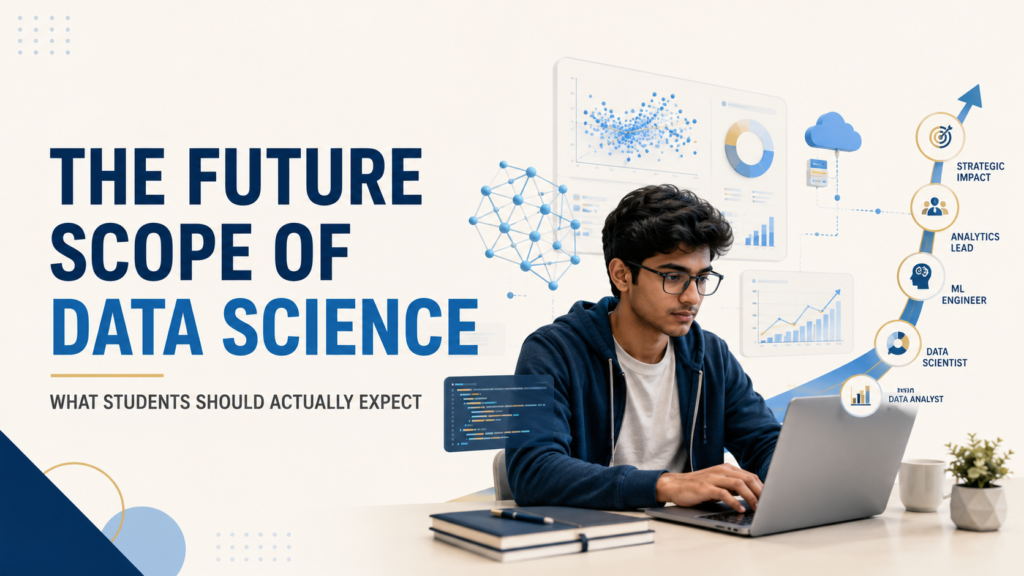
“Data scientist” was always a fuzzy job title. It is now splitting into distinct roles with different futures.
Data Analyst — cleans, queries and visualises data to answer business questions. Highest volume of openings, lowest entry barrier, best starting point for most students. AI tools have made parts of this job faster, which means analysts are now expected to cover more ground rather than fewer.
Data Engineer — builds and maintains the pipelines that move data around. Quietly the most secure role in the entire field, because every model depends on infrastructure that someone has to build and keep running. Underrated by students, in high demand by employers.
Machine Learning Engineer — takes models into production and keeps them working there. NASSCOM-BCG data shows AI engineer roles grew 67% year-on-year, with a majority of newer postings specifically asking for retrieval-augmented generation and vector database experience — reflecting the industry’s shift from experimenting with AI to deploying it in production. Masai School
Data Scientist (research-leaning) — designs experiments and builds novel models. Fewest openings, highest qualification bar, usually needs a master’s or PhD. This is the role students imagine and the one hardest to enter directly.
AI Product and AI-fluent domain roles — a growing category of people who aren’t engineers but who work fluently with AI systems inside marketing, finance, operations or HR. Companies are hiring AI-fluent people into existing functions almost as often as they’re hiring dedicated AI specialists. Masai School
That last category deserves attention. It means data literacy is becoming valuable outside data teams — including for commerce and management students who never intend to write production code.
Will AI make data scientists obsolete?
The honest answer: AI is eliminating parts of the job, not the job.
Writing boilerplate code, producing a first-pass exploratory analysis, generating a chart, drafting a SQL query — these are now largely assisted or automated. A task that took an afternoon takes twenty minutes.
What has not been automated is the part that was always hardest: knowing which question to ask, whether the data can answer it, whether the answer is trustworthy, and what the business should do about it. Framing problems, checking assumptions and communicating findings to people who won’t read the notebook — that work has become more valuable, not less, because the volume of easily-generated analysis has exploded and someone has to judge whether any of it is sound.
The people at risk are those whose entire contribution was executing routine analysis. The people benefiting are those who use the tools to work at greater scale.
What to study after 12th to get into data science
There is no single mandatory course. There are several viable routes.
BCA (Bachelor of Computer Applications) — three years of programming, databases and application development. A strong practical foundation, and the most accessible route for students who want to build rather than theorise. Pair it with statistics and Python from your first year.
B.Sc in Statistics, Mathematics or Data Science — the strongest theoretical base. Best route if you’re aiming for research roles or a master’s degree.
B.Tech in CSE / IT / AI-ML — the conventional path, and still the one most large recruiters filter for.
B.Com or BBA with analytics — a real route that gets dismissed too easily. Business analysts, financial analysts and marketing analytics roles all want people who understand the business first. Add SQL, Excel at a serious level, Python and a visualisation tool, and you are competitive for analyst roles that a pure CS graduate often can’t do well because they don’t understand the domain.
What matters more than the degree label:
- Statistics. Not a certificate in it — actual comfort with distributions, sampling, hypothesis testing and regression. This is the foundation everything else stands on.
- SQL. Every data role uses it, every day. Learn it properly and early.
- Python. Pandas, NumPy, scikit-learn to begin with.
- One visualisation tool. Power BI or Tableau.
- Projects with real data. Not tutorial datasets. Pull real data — from a local business, from government open data portals, from a public API — and solve a problem someone actually has.
That last point is the one that decides interviews. Everyone applying will have the certificates.
The realistic salary picture
Entry-level data analyst roles in India commonly start in the ₹3.5–7 lakh range, with metro roles and product companies paying at the higher end. Machine learning and data engineering roles start higher. Experienced professionals with production deployment experience command significantly more, which is where the eye-catching figures come from.
Two cautions. First, advertised averages are pulled upward by a small number of very high offers — the median fresher outcome is well below the average you’ll see quoted. Second, the premium goes to demonstrated capability, not to the course you took. Two graduates from the same programme routinely land at very different salary points based on what they built.
What this means for a student in Mysuru
You do not need to be in Bengaluru to enter this field, and that has become more true, not less. Remote and hybrid analyst roles are common, GCCs are expanding into tier-2 cities, and the portfolio you build is visible from anywhere.
What you do need is three years of deliberate work rather than three years of attendance.
At Trinity College, Mysore, our BCA programme is built around exactly that gap between knowing and building — practical labs, applied projects and faculty mentorship, supported by our partnerships with academic and industry entities. Students from our commerce and science streams who want to move toward analytics are guided on which skills to layer onto their degree rather than left to work it out from YouTube.
The scope is real. Whether it becomes your scope depends on what you produce between now and graduation.
Frequently asked questions
What is the scope of data science in the future in India?
Strong and broadening. NASSCOM projects demand crossing one million professionals against a much smaller trained pool, and demand is spreading from IT into banking, healthcare, retail, manufacturing and government. The growth is increasingly in domain-specific applied roles rather than general data science positions.
Is data science still a good career in 2026?
Yes, but the entry bar has risen. Employers now filter for people who can deploy and maintain working systems rather than those who only understand the theory. Students who build real projects during their degree are in a strong position; those relying on certificates alone are not.
Will AI replace data scientists?
AI is automating routine parts of the work — code generation, first-pass analysis, chart production. It has not replaced problem framing, judgement about data quality, or the ability to translate findings into business decisions. Those parts of the role have become more valuable.
Which course is best for data science after 12th?
BCA, B.Sc in Statistics or Mathematics, and B.Tech in CSE or AI-ML are the most direct routes. B.Com or BBA students can also enter analytics roles by adding SQL, Python, statistics and a visualisation tool alongside their degree.
Can commerce students get into data science?
Yes. Business, financial and marketing analytics roles specifically value domain understanding. Commerce students who build strong SQL, Excel, Python and statistics skills are competitive for analyst roles, particularly in BFSI.
What skills should I start with?
Statistics first, then SQL, then Python. Add a visualisation tool such as Power BI or Tableau, and build two or three projects using real data rather than tutorial datasets.
The short version
The scope of data science in the future is not shrinking — it is becoming more demanding and more specific. Broad demand, a genuine talent gap, and expanding geography all point the same way.
What has changed is who gets in. The certificate era is over. The portfolio era is here.
Start early, pick a domain, and build things nobody assigned you.
Admissions for BCA, B.Com and BBA at Trinity College, Mysore are open. Visit our campus at Vijayanagar 2nd Stage or speak to our admissions team about which programme fits your career direction.
About the author
Dr Shama E Milton
Principal, Trinity Institutions
Dr Shama E Milton leads Trinity Institutions, a PU and degree college in Vijayanagar 2nd Stage, Mysuru, offering programmes in commerce, management and computer applications, including BCA, B.Com and BBA. Under her leadership, Trinity fosters ambition through industry-connected curricula and partnerships with leading academic and industry entities, while promoting collaboration, inclusivity, social responsibility and ethical conduct among students and faculty.