
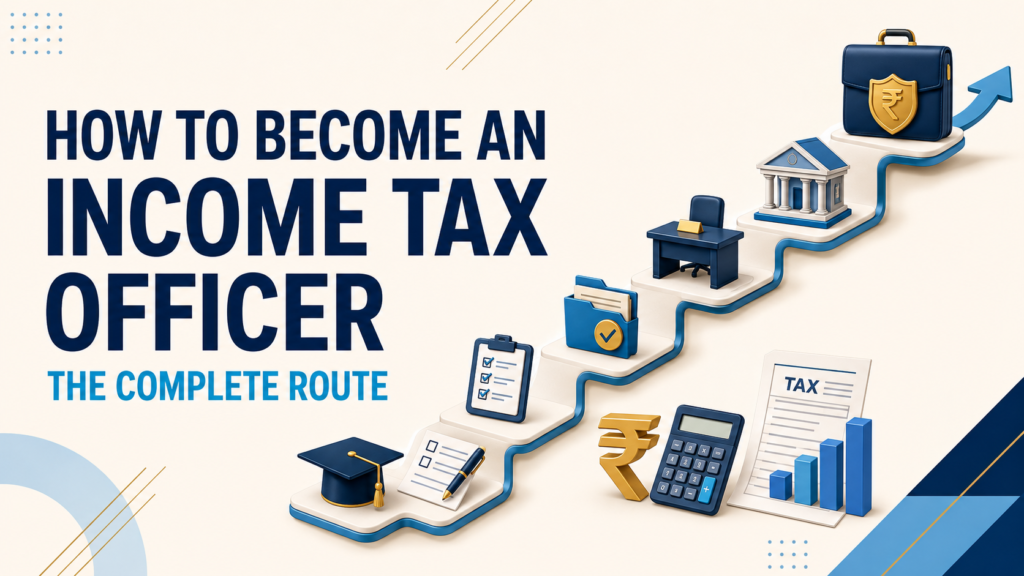
Ask a room of commerce students what they want to do, and a few hands go up for Income Tax Officer. Ask them how you actually become one, and the answers get vague.
Here’s the thing almost every guide on how to become an income tax officer gets wrong by omission: you cannot apply to be an Income Tax Officer. There is no exam with that name and no direct recruitment to that post for a fresh graduate.
ITO is a rank you reach — either by joining the department a level below and getting promoted, or by entering above it through the civil services. Understanding that distinction is the whole map, and most aspirants only discover it after they’ve already picked a preparation strategy.
This guide lays out both routes properly: eligibility, exam pattern, timelines, salary and what a student should be doing during their degree years.
First, get the hierarchy right
< cite index=”78-1″>The Income Tax Officer post is Group B Gazetted, recruited through promotion from the Inspector cadre. The Indian Revenue Service (IRS) is a Group A Central Service recruited through the UPSC Civil Services Examination, and IRS officers enter at Assistant Commissioner of Income Tax level — two grades above ITO — skipping the Inspector and ITO grades entirely.</cite>
So there are exactly two realistic paths:
Route 1 — SSC CGL. Join as Income Tax Inspector, get promoted to ITO. This is how most officers get there.
Route 2 — UPSC Civil Services. Join as IRS at ACIT level, which is already above ITO. Harder, faster, higher ceiling.
Pick your route before you pick your books. The two exams test very different things.
Route 1: SSC CGL — the standard path
What you’re actually applying for
You apply for Income Tax Inspector, one of the posts offered through the Staff Selection Commission’s Combined Graduate Level examination. < cite index=”63-1″>The SSC CGL vacancy list includes Assistant Section Officer, Income Tax Inspector, Central Excise Inspector, Auditor, Accountant, Tax Assistant and several other posts.</cite>
Scale, for context: < cite index=”63-1″>the SSC CGL 2026 notification was released for 12,256 vacancies across Group B and Group C posts, with Tier 1 scheduled from August to September 2026 and Tier 2 in December 2026.</cite>
Eligibility
Educational qualification. < cite index=”63-1″>A bachelor’s degree in any discipline from a recognised university. Candidates in their final year of graduation can also apply, provided they hold the qualification before the cutoff date.</cite>
That last point matters for students: you can sit the exam in your final year of B.Com or BBA. You do not have to wait until you graduate.
Age limit. < cite index=”65-1″>For Income Tax Inspector, the age range is 18 to 30 years, with relaxations of 5 years for SC/ST, 3 years for OBC, 10 to 15 years for PwBD and 3 years for ex-servicemen.</cite>
Two cautions on age. < cite index=”67-1″>The “18–32 years” figure often quoted online is the range across all SSC CGL posts combined — no single post spans that whole range, so check the limit for your specific post.</cite> And < cite index=”67-1″>only the date of birth recorded on your Class 10 / matriculation certificate is accepted, with no correction entertained after submission even if Aadhaar or PAN shows a different date.</cite>
Stream. Any. Commerce, science, arts — no restriction. Commerce students do have a natural advantage in the taxation-related work later, but it isn’t an eligibility condition.
Selection process
< cite index=”66-1″>The Income Tax Inspector selection process involves clearing SSC CGL Tier 1 and Tier 2, followed by Document Verification, with final selection based on merit.</cite>
Tier 1 — computer-based, covering General Intelligence and Reasoning, Quantitative Aptitude, English Comprehension and General Awareness. < cite index=”69-1″>Tier 1 carries 200 marks total, with negative marking and sectional timing, which makes time management as important as syllabus coverage.</cite>
Important structural point: < cite index=”64-1″>Tier 1 is qualifying in nature, and the final merit is based on Tier 2 performance.</cite> Students routinely over-prepare for Tier 1 and under-prepare for Tier 2, which is the exam that actually decides selection.
Tier 2 — < cite index=”64-1″>Paper I is compulsory for Income Tax Inspector, covering Mathematics, Reasoning, English and General Awareness, along with Computer Knowledge and a Data Entry Speed Test.</cite>
Document Verification — < cite index=”66-1″>candidates must present original documents and an official photo ID, and the date of birth on the ID must match the Admission Certificate, with any mismatch potentially resulting in disqualification.</cite>
There is also a physical standard and physical test requirement for the Inspector post — check the current notification for the specific measurements and running/walking standards, as these are post-specific.
From Inspector to Income Tax Officer
This is the part of the journey people plan for least and spend the longest in.
How the promotion works. You serve as Inspector, maintain a clean service record, and clear the departmental examination conducted by the Income Tax Department. Promotion is then made based on seniority, service record and available vacancies.
How long it takes. Here you should be sceptical of any single number you read. Published estimates vary considerably — some sources cite < cite index=”74-1″>3 to 4 years minimum with the departmental exam, or 6 to 8 years without it</cite>, others say < cite index=”77-1″>typically 5 to 6 years of service</cite>, and others put it at < cite index=”78-1″>8 to 12 years</cite>.
The reason for the spread is real: promotion depends on your zone. Some regions have far more Inspectors waiting than vacancies opening; others move faster. An Inspector in a low-vacancy zone can wait significantly longer than one in a high-attrition zone for exactly the same performance.
Plan for a decade, be pleased if it’s faster.
Route 2: UPSC Civil Services (IRS)
If ITO is the goal, the UPSC route technically overshoots it — you enter above that rank.
< cite index=”78-1″>IRS officers recruited through UPSC CSE enter at ACIT level (Pay Level 10). An IRS officer will typically be a Joint Commissioner within 10 to 12 years of service, whereas an officer who started as an Inspector might take 20 or more years to reach the same grade.</cite>
Eligibility: graduation in any discipline, age generally 21 to 32 for the general category with category-based relaxations. Structure: Prelims, Mains and Interview, with the Mains requiring an optional subject — and commerce and accountancy is a legitimate, well-regarded optional for B.Com students.
The honest comparison: UPSC has a far lower success rate and a longer preparation cycle. SSC CGL is more achievable, more predictable and still leads to a strong career. Many successful aspirants prepare for SSC CGL while attempting UPSC, since the general studies overlap is substantial and one is a genuine fallback for the other.
The money
Income Tax Inspector. < cite index=”71-1″>Selected candidates are placed at Pay Level 7, with a pay scale ranging from ₹44,900 to ₹1,42,400 and grade pay of ₹4,600.</cite> < cite index=”71-1″>In a Class Y city — which includes Mysore — the final in-hand salary after allowances and deductions falls roughly in the ₹58,000 to ₹63,000 range.</cite>
Income Tax Officer. < cite index=”73-1″>ITOs operate at Pay Level 8 with grade pay of ₹4,800 and basic pay starting at ₹47,600, with newly promoted officers taking home roughly ₹80,000 to ₹92,000 per month.</cite>
Beyond that. The ladder continues through Assistant Commissioner, Deputy Commissioner, Joint Commissioner, Additional Commissioner, Commissioner and above, with corresponding pay levels.
Worth noting alongside the numbers: pension, medical coverage, housing allowance, job security and the authority of a gazetted post. For many families, those matter more than the headline figure.
What to study during your degree
Any degree qualifies. But some choices make the road easier.
B.Com is the most natural fit. Direct tax, income tax law, accounting, auditing and business law are all in the syllabus — meaning your degree is doing double duty as preparation for the taxation work you’ll eventually do, and as groundwork for a commerce optional if you attempt UPSC.
BBA works too, particularly for students who want the management and general studies breadth. The quantitative aptitude portions of SSC CGL are not commerce-specific.
What actually matters more than the degree label:
- Quantitative aptitude, worked daily. Arithmetic, algebra, data interpretation. This is the single biggest differentiator in SSC CGL scores.
- English. Grammar, vocabulary, comprehension. Consistently underrated by aspirants.
- General awareness. Current affairs, Indian polity, economy, history, geography. Build the newspaper habit in year one, not in your final semester.
- Typing speed. There is a data entry component. It takes weeks to fix and costs candidates who ignore it.
A realistic timeline for a degree student
First year: Build fundamentals. Daily quantitative aptitude practice and a newspaper. No exam-specific coaching needed yet.
Second year: Start the SSC CGL syllabus properly. Begin sectional practice. Decide whether UPSC is also in your plan, because that changes your reading.
Third year: Full preparation mode. Mock tests weekly, then twice weekly. Apply for SSC CGL in your final year — you’re eligible, and even if you don’t clear it, you get an attempt’s worth of real exam experience for free.
Post-graduation: Full-time preparation if needed, with multiple attempts available within your age window.
The students who succeed treat this as a three-year project running alongside their degree, not a one-year sprint after it.
Four mistakes that cost aspirants years
Preparing hard for Tier 1 and treating Tier 2 as an afterthought. Tier 1 only qualifies you. Tier 2 decides your rank and therefore your post.
Ignoring post preference order. You rank your preferred posts in the application. Get this wrong and you can clear the exam with a good score and still land somewhere you didn’t want.
Assuming ITO is a direct recruitment. It isn’t. Aspirants who don’t understand this waste time looking for an exam that doesn’t exist.
Waiting until after graduation to start. The age window is finite, attempts are limited by it, and preparation compounds. Final-year students are eligible — use that.
Preparing at Trinity
At Trinity First Grade College, Mysore, our B.Com and BBA programmes are built around the understanding that a significant share of commerce students are aiming at government service — and that the syllabus alone doesn’t get them there.
Our faculty guide students on how to run competitive exam preparation alongside their degree rather than after it, and our focus on strong fundamentals in taxation, accounting and business law gives commerce students a genuine head start on the subject matter they’ll work with as officers.
If becoming an Income Tax Officer is your goal, the useful thing to know is that the work starts now, in your first year — not on the day you collect your degree certificate.
Frequently asked questions
How can I become an Income Tax Officer after graduation?
There is no direct recruitment to the ITO post. The standard route is to clear SSC CGL and join as an Income Tax Inspector, then be promoted to ITO after completing the required service and clearing the departmental examination. The alternative is UPSC Civil Services, where IRS officers enter at ACIT level, above ITO.
What is the eligibility for Income Tax Inspector?
A bachelor’s degree in any discipline from a recognised university, and an age between 18 and 30 years with category-based relaxations. Final-year students can apply provided they hold the degree before the cutoff date.
Which degree is best for becoming an Income Tax Officer?
Any degree qualifies. B.Com is the most useful in practice because its taxation, accounting and business law content overlaps directly with the department’s work and supports a commerce optional if you also attempt UPSC.
How long does it take to become an ITO from Inspector?
Estimates vary widely — from around 3 to 4 years with the departmental examination to 8 to 12 years — because promotion depends heavily on zone-wise vacancies and seniority alongside performance.
What is the salary of an Income Tax Officer?
ITOs are at Pay Level 8 with basic pay starting at ₹47,600 and in-hand pay of roughly ₹80,000 to ₹92,000 per month. Income Tax Inspectors are at Pay Level 7, with a scale of ₹44,900 to ₹1,42,400.
Is Income Tax Inspector a gazetted post?
No. Income Tax Inspector is a Group B non-gazetted post. The officer becomes Group B gazetted on promotion to Income Tax Officer.
The short version
You don’t apply to be an Income Tax Officer. You clear SSC CGL, join as an Inspector, and earn the rank — or you clear UPSC and enter above it.
Both routes start with a graduation degree and a set of skills you can begin building in your first year of college. The exam will still be there when you’re ready. The years you spend not preparing won’t come back.
Admissions for B.Com and BBA at Trinity College, Mysore are open. Visit our campus at Vijayanagar 2nd Stage or speak with our admissions team about building a degree around your competitive exam goals.
About the author
Dr Shama E Milton
Principal, Trinity Institutions
Dr Shama E Milton leads Trinity Institutions, a PU and degree college in Vijayanagar 2nd Stage, Mysuru, offering programmes in commerce, management and computer applications, including B.Com, BBA and BCA. Under her leadership, Trinity fosters ambition through industry-connected curricula and partnerships with leading academic and industry entities, while promoting collaboration, inclusivity, social responsibility and ethical conduct among students and faculty.