
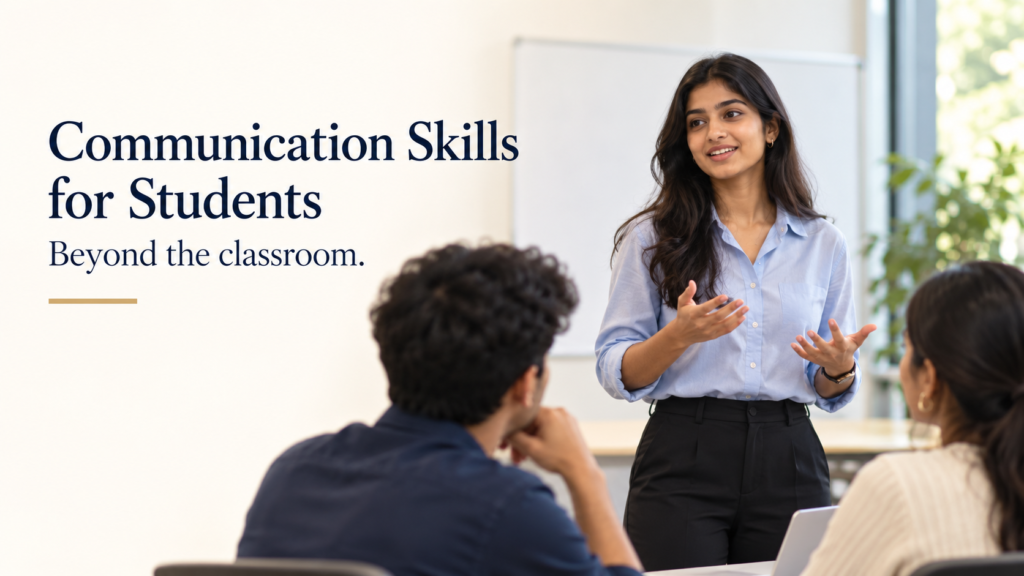
Why Are Communication Skills Important for Students?
Communication skills for students are important because almost everything in college and work depends on them: asking doubts, writing answers, working in teams, giving presentations and clearing interviews. Strong communicators learn faster, make friends more easily, and are trusted with responsibility earlier.
Employers agree. The World Economic Forum’s Future of Jobs Report 2025 found that half of employers consider empathy and active listening a core skill for their workforce, and 61% name leadership and social influence. Both depend heavily on communication.
Here is how communication helps at each stage:
Stage | How Communication Helps |
In class | Asking doubts, joining discussions, getting clarity faster |
In exams | Writing clear, structured answers that are easy to mark |
In group work | Sharing ideas, solving disagreements, dividing tasks |
In interviews | Explaining your skills and experience with confidence |
At work | Writing emails, presenting reports, working with clients |
4 Types of Communication Every Student Needs
Students use four types of communication every day: verbal, written, non-verbal and listening. Each one is a separate skill. Many students are good at one or two and weak at the others, so it helps to know which areas you need to work on.
1. Verbal Communication
Speaking clearly in class, in groups and on stage. Good verbal communication means organising your thoughts before you speak, using simple words and speaking at a steady pace.
2. Written Communication
Exam answers, assignments, emails and project reports. Clear writing uses short sentences, logical order and correct grammar. It is one of the most underrated skills in college.
3. Non-Verbal Communication
Your body language, eye contact, posture and facial expressions. A firm posture and steady eye contact make you look confident, even when you feel nervous.
4. Listening
The skill most people forget. Good listeners understand instructions the first time, ask better questions and make others feel respected.
“The most important thing in communication is hearing what isn’t said.” Peter Drucker, management thinker
How Can Students Improve Their Communication Skills?
The fastest way to build communication skills for students is small, regular practice: reading daily, speaking up in class, writing short summaries and listening without interrupting. Improvement comes from repetition and feedback. Ten minutes of practice every day does more than one long workshop.
- Read every day: Newspapers, good books and articles build vocabulary and sentence sense.
- Speak up once in every class: Ask one question or share one point. It gets easier each time.
- Summarise what you learn: Write three lines after each lecture. This trains clear writing.
- Record yourself: Speak on a topic for one minute and listen back. You will notice filler words and pace.
- Practise active listening: Let others finish. Repeat their point in your own words before you reply.
- Write clear emails: Use a subject line, a greeting, a short message and a polite close.
- Join debates or clubs: They give you a safe space to practise in front of others.
Presentation Skills for Students: How to Speak With Confidence
Presentation skills help students explain ideas to a group with clarity and confidence. The secret is preparation, not talent. Know your content, plan a simple structure, practise aloud, and focus on the audience instead of your nerves. Most confident speakers were once nervous beginners.
Use this simple structure for any presentation:
- Opening: Start with a question, a fact or a short story to get attention.
- Three main points: Audiences remember three points far better than ten.
- Examples: Use real examples or simple visuals for each point.
- Closing: Summarise in one or two lines and thank the audience.
A few tips for handling nerves:
- Practise aloud at least three times before the day.
- Keep slides simple, with few words and clear visuals.
- Look at friendly faces in different parts of the room.
- Slow down. Nervous speakers tend to rush.
- Pause instead of saying “umm.” Silence sounds more confident than filler words.
Good presenters also make good team leaders. If you want to grow further, read our guide on how to lead a team with confidence.
Common Communication Mistakes Students Make
Most communication problems come from a few habits that are easy to fix once you notice them.
- Speaking before thinking: Take two seconds to organise your answer.
- Using too much jargon: Simple words are easier to understand and sound more confident.
- Interrupting: It signals that you are not listening.
- Avoiding eye contact: It can make you seem unsure, even if you know the topic well.
- Long, unclear messages: Whether in an email or an exam answer, shorter and clearer is better.
Communication Skills and Your Career
Communication skills for students become even more valuable after college. Commerce and management careers, in particular, depend on explaining numbers, writing reports and working with clients. Students in our BCom degree programme, for example, go on to roles in accounting, banking and finance, where clear communication is a daily requirement.
Communication is also the base of many other abilities. To see how it connects with teamwork, adaptability and emotional intelligence, read our guide on soft skills that marks cannot measure.
Frequently Asked Questions
What are communication skills for students?
Communication skills are the abilities to speak clearly, write well, use positive body language and listen carefully. Students use them in class discussions, exams, group projects, presentations and interviews.
How can I improve my communication skills quickly?
Read daily, speak up at least once in every class, summarise lectures in writing, and record yourself speaking for one minute. Regular small practice improves communication faster than occasional long sessions.
How do communication skills for students help in placements?
Placement rounds test communication at every stage: group discussions, HR interviews and how clearly you explain your projects. Students who speak clearly and listen well often stand out even when marks are similar.
How can a shy student improve communication?
Start small and safe. Speak in small groups first, prepare points before class, and volunteer for short tasks like introducing a speaker. Confidence grows with each small success.
Is English fluency the same as good communication?
No. Good communication means being clear, organised and easy to understand. You can communicate very well in simple English. Fluency improves with reading and practice, but clarity matters most.
Why do employers value communication skills?
Because almost every job involves working with people. Employers need staff who can understand instructions, share updates, write clearly and represent the company well with clients.
Final Thoughts
Communication skills for students are not just for exams or interviews. They shape how teachers see you, how friends trust you and how employers judge you. Read a little, speak a little and listen a lot every day. The improvement will surprise you within a semester.
At Trinity College, presentations, clubs, debates and industry interactions are part of everyday student life. Explore Trinity College Mysore to see how we help students find their voice.
About the Author
Dr Shama E Milton is the Principal of Trinity Institutions, Mysuru. Trinity offers PU programmes in Science and Commerce and degree programmes in BCA, BBA and BCom affiliated to the University of Mysore. She writes for students and parents on study habits, life skills and the choices that shape a student’s future.
Sources
- World Economic Forum, The Future of Jobs Report 2025, January 2025