Why Do Students Need More Than Marks Today?
Students need more than marks because employers now hire for ability, attitude and adaptability, not just qualifications. Technology changes job roles every few years. The students who do well are those who can learn new things quickly, work with people and solve problems they have not seen before.
According to the World Economic Forum’s Future of Jobs Report 2025, analytical thinking is the top core skill, named by 69% of employers surveyed across 55 economies. Resilience and flexibility came second at 67%, followed by leadership and social influence at 61%.
The Indian picture is similar. The India Skills Report 2026 put national employability at 56.35%, with commerce graduates rising to 62.81%. Progress is real, but nearly half of young candidates are still not considered job-ready.
The Top 10 Skills for Students
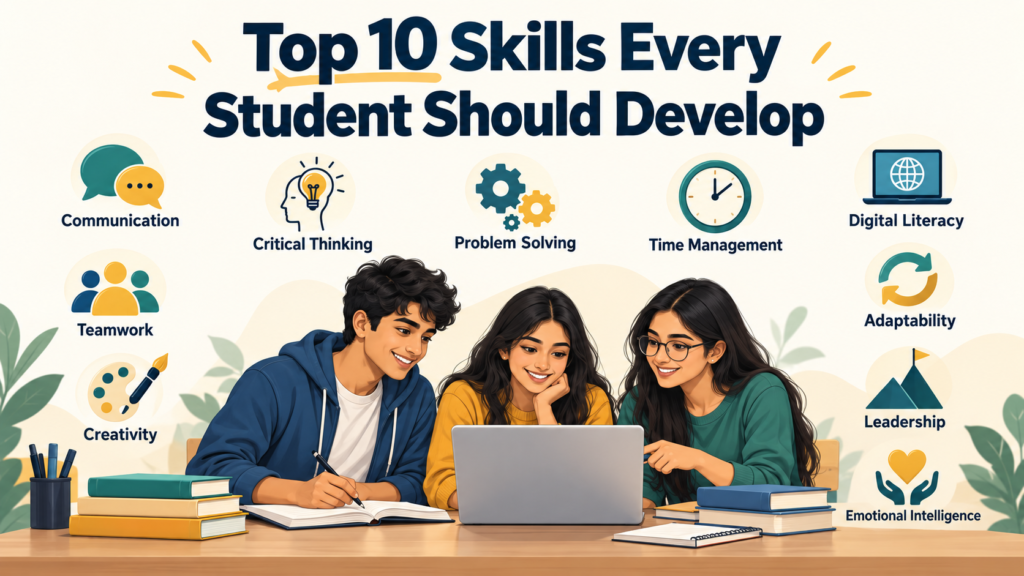
The top 10 skills for students are communication, critical thinking, time management, learning how to learn, digital and AI literacy, teamwork, leadership, adaptability, emotional intelligence and financial literacy. Together, they cover how you think, how you work with others and how you manage yourself.
# | Skill | Why It Matters |
1 | Communication | Turns knowledge into something others understand |
2 | Critical thinking and problem solving | The top skill employers ask for |
3 | Time management | Balances studies, life and deadlines |
4 | Learning how to learn | Keeps you relevant as jobs change |
5 | Digital and AI literacy | Required in almost every modern role |
6 | Teamwork | Most work happens in teams |
7 | Leadership | Builds trust and responsibility early |
8 | Adaptability and resilience | Helps you handle setbacks and change |
9 | Emotional intelligence | Improves relationships and self-control |
10 | Financial literacy | Helps you manage money wisely from day one |
1. Communication
Clear speaking, simple writing and careful listening. Communication supports almost every other skill on this list. Read our full guide on communication skills for practical exercises.
How to build it: Speak up once in every class, read daily and write short summaries after lectures.
2. Critical Thinking and Problem Solving
The ability to question information, look at evidence and find workable solutions. In an age of social media and AI-generated content, this skill protects you from misinformation.
How to build it: Join debates, solve case studies and ask “why” and “how do we know?” when you read something.
3. Time Management
Planning your day so that studies, family, rest and hobbies all get their share. Students who manage time well rarely panic before exams.
How to build it: Use a weekly planner (see the sample below) and study in timed blocks.
4. Learning How to Learn
Knowing which methods help you understand and remember. This skill pays off for life, because you will keep learning new tools and topics at work.
How to build it: Try active recall and spaced revision. Our guide on learning how to study explains the methods researchers rate highest.
5. Digital and AI Literacy
Using computers, spreadsheets, online research and AI tools responsibly. Employers increasingly expect graduates to be comfortable with technology in any role.
How to build it: Learn spreadsheets well, try AI tools for brainstorming (not copying), and check facts from reliable sources.
6. Teamwork
Working well with people who think differently, sharing responsibility and resolving disagreements calmly.
How to build it: Take group projects seriously, join clubs and volunteer for college events.
7. Leadership
Taking initiative, guiding others and taking responsibility for results. Leadership is not a title. It is a habit you can start practising today. Read more about leadership skills and how to build them early.
How to build it: Lead a club activity, organise a class event or mentor a junior.
8. Adaptability and Resilience
Handling change, failure and pressure without giving up. Every student faces a bad exam, a rejection or a difficult semester. Resilience decides what happens next.
How to build it: Treat setbacks as feedback, keep a routine during tough times and talk to mentors.
9. Emotional Intelligence
Understanding your own emotions and those of others. It helps you stay calm under pressure, handle criticism and build strong friendships.
How to build it: Pause before reacting, listen fully and notice how others feel in group situations.
10. Financial Literacy
Understanding budgeting, saving, banking and basic investing. Many young people earn their first salary without knowing how to manage it.
How to build it: Track your monthly spending, learn how bank accounts and UPI work safely, and read basic personal finance articles.
Time Management Skills for Students: A Sample Weekly Plan
Good time management means deciding in advance where your hours go, so studies, skill building and rest all fit into the week. A simple weekly plan prevents last-minute panic and makes space for clubs, internships and hobbies that build the other skills on this list.
Day | Main Focus | Skill Building |
Monday | Toughest subject revision | Read news for 15 minutes |
Tuesday | Practice problems | Club or association activity |
Wednesday | Assignment work | Practise a short presentation |
Thursday | Self-testing and doubts | Learn a spreadsheet or digital skill |
Friday | Weak topics | Group project meeting |
Saturday | Weekly revision | Volunteering, sports or internship |
Sunday | Light review and planning | Rest, family and hobbies |
How Can Students Build These Skills in College?
Students build these skills by combining classroom learning with real experience: clubs, internships, competitions, volunteering and personal projects. No single course teaches all ten. The key is to choose activities that stretch you a little beyond your comfort zone every semester.
- First year: Focus on communication, time management and learning how to learn.
- Second year: Add teamwork, leadership and digital skills through clubs and projects.
- Final year: Strengthen adaptability, emotional intelligence and financial literacy through internships and real responsibilities.
Many of these overlap with soft skills, the personal qualities that marks cannot measure. Our guide on soft skills explores them in more depth.
As a PU and degree college in Mysore, Trinity offers clubs, NSS, NCC, Rotaract, internships, industry interactions and add-on courses in areas like Artificial Intelligence and Machine Learning, so students can build these skills alongside their academics.
Frequently Asked Questions
What are the top 10 skills for students?
Communication, critical thinking, time management, learning how to learn, digital and AI literacy, teamwork, leadership, adaptability, emotional intelligence and financial literacy. Together they prepare students for both higher studies and work.
Which skill is most important for students in 2026?
Critical thinking and problem solving top most employer surveys. The World Economic Forum’s 2025 report found 69% of employers consider analytical thinking a core skill. Communication is a close second because it supports everything else.
How can students improve time management skills?
Plan your week in advance, study in timed blocks, keep your phone away during study time and review your progress every Sunday. Small daily habits build strong time management over a semester.
At what age should students start building these skills?
The earlier the better. PU is an excellent time to start, because habits formed at 16 or 17 carry into degree college and work. But it is never too late to begin.
Can these skills be learned outside the classroom?
Yes, most of them are learned outside the classroom, through clubs, sports, volunteering, part-time work, internships and personal projects. Classroom learning gives the base; real experience builds the skill.
Final Thoughts
The top 10 skills for students are not extra work on top of your studies. They are what turn your studies into a career. Pick two skills this semester, find one activity that builds each, and track your progress. In three years, you will be a very different graduate.
If you want a college that builds both knowledge and skills, explore Trinity College Mysore and its PU, BCA, BBA and BCom programmes.
About the Author
Dr Shama E Milton is the Principal of Trinity Institutions, Mysuru. Trinity offers PU programmes in Science and Commerce and degree programmes in BCA, BBA and BCom affiliated to the University of Mysore. She writes for students and parents on study habits, life skills and the choices that shape a student’s future.
Sources
- World Economic Forum, The Future of Jobs Report 2025, January 2025
- India Skills Report 2026, Wheebox and ETS with CII, AICTE and AIU, November 2025