
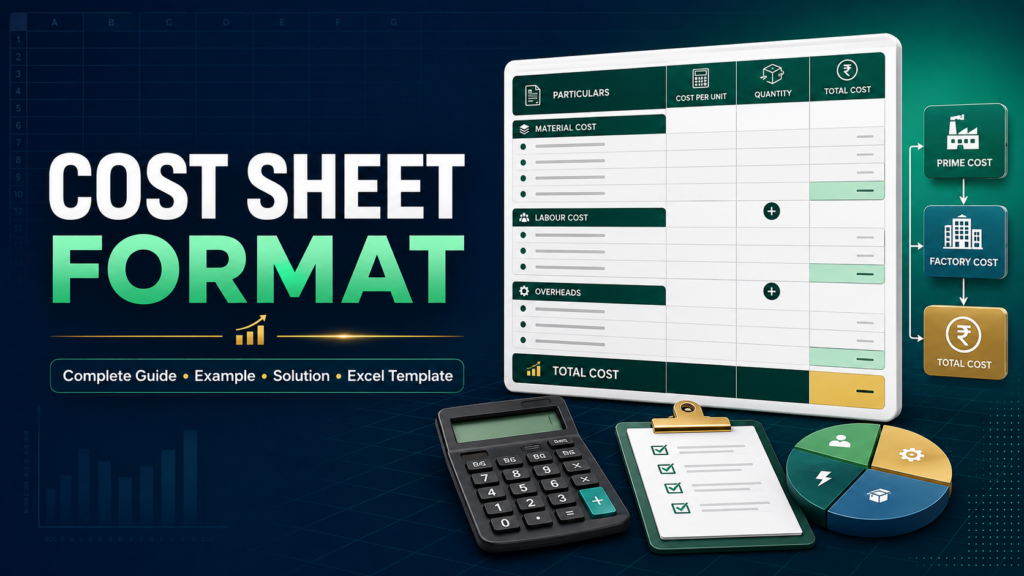
A cost sheet is the single document that answers the question every business owner eventually asks: where exactly did the money go, and what should I charge? It takes total expenditure apart, stage by stage, until you can see what your product costs to make, what it costs to sell, and how much of the selling price is actually profit.
For B.Com and BBA students, the cost sheet is the foundation of the entire Cost Accounting paper. Get the sequence of the four stages right and most problems in the syllabus become mechanical. Get it wrong and every subsequent chapter, from tender pricing to marginal costing, collapses.
This guide covers the standard format of a cost sheet, what belongs in each stage, the items that must be excluded, a fully worked example with solution, the job cost sheet, tender and builder variations, and how to build the whole thing in Excel.
What is a Cost Sheet?
A cost sheet is a statement that presents the total cost and the per unit cost of a product or service for a given period, arranged in stages so that each element of cost and the cumulative cost at every stage can be identified separately.
It is a statement, not a ledger account. It has no debit and credit sides, follows no double entry rules, and is prepared purely for management information. That is why it is sometimes called a Statement of Cost.
A cost sheet serves four purposes: it discloses the total and per unit cost, it shows the breakup of every cost element, it enables comparison with previous periods, and it provides the basis for fixing selling prices and submitting tenders.
The Four Stages of Cost
Every cost sheet moves through four cumulative stages. Learn this sequence and the format writes itself.
Direct Material + Direct Labour + Direct Expenses
                    ↓
              PRIME COST
                    ↓
        + Factory / Works Overheads
        ± Work in Progress adjustment
                    ↓
        WORKS COST or FACTORY COST
                    ↓
      + Office & Administration Overheads
                    ↓
          COST OF PRODUCTION
                    ↓
        ± Finished Goods adjustment
                    ↓
           COST OF GOODS SOLD
                    ↓
      + Selling & Distribution Overheads
                    ↓
        COST OF SALES or TOTAL COST
                    ↓
                + Profit
                    ↓
                  SALES
Two rules govern the stock adjustments and they trip up students constantly:
- Work in progress is adjusted after adding factory overheads, because partly finished goods have already absorbed factory overhead
- Finished goods stock is adjusted after cost of production, because completed goods carry administration overhead but not selling overhead
Format of Cost Sheet in Cost Accounting
This is the standard format expected in university examinations.
| Particulars | Amount (₹) | Amount (₹) |
|---|---|---|
| Opening Stock of Raw Materials | xxx | |
| Add: Purchase of Raw Materials | xxx | |
| Add: Carriage Inward | xxx | |
| Less: Purchase Returns | (xxx) | |
| Less: Sale of Scrap of Raw Material | (xxx) | |
| Less: Closing Stock of Raw Materials | (xxx) | |
| Direct Material Consumed | xxx | |
| Add: Direct Labour or Direct Wages | xxx | |
| Add: Direct or Chargeable Expenses | xxx | |
| PRIME COST | xxx | |
| Add: Factory or Works Overheads | xxx | |
| Gross Works Cost | xxx | |
| Add: Opening Work in Progress | xxx | |
| Less: Closing Work in Progress | (xxx) | |
| Less: Sale of Factory Scrap | (xxx) | |
| WORKS COST or FACTORY COST | xxx | |
| Add: Office and Administration Overheads | xxx | |
| COST OF PRODUCTION | xxx | |
| Add: Opening Stock of Finished Goods | xxx | |
| Less: Closing Stock of Finished Goods | (xxx) | |
| COST OF GOODS SOLD | xxx | |
| Add: Selling and Distribution Overheads | xxx | |
| COST OF SALES or TOTAL COST | xxx | |
| Add: Profit | xxx | |
| SALES | xxx |
In examination problems a second column headed “Cost per unit” is usually required alongside the total column. Divide each total by the number of units, but be careful: divide by units produced up to cost of production, and by units sold from cost of goods sold onward.
What Goes Into Each Overhead Group
| Group | Typical items |
|---|---|
| Direct Material | Raw materials consumed, primary packing material, components bought for the product |
| Direct Labour | Wages of workers directly engaged in production |
| Direct Expenses | Hire of special plant for a job, royalty on production, cost of special designs or moulds, subcontracting charges |
| Factory Overheads | Indirect materials, indirect wages, factory rent, factory power and fuel, depreciation on plant, works manager salary, factory insurance, repairs to machinery, drawing office expenses, factory lighting |
| Office and Administration Overheads | Office rent and rates, office salaries, printing and stationery, telephone, legal charges, audit fee, directors’ fees, depreciation on office equipment, office lighting |
| Selling and Distribution Overheads | Advertising, salesmen salaries and commission, showroom expenses, carriage outward, packing for delivery, warehouse rent, bad debts, delivery van running costs, catalogues and price lists |
Two items cause repeated confusion. Packing is a direct material when it is primary packing needed to make the product saleable, and a selling overhead when it is secondary packing for delivery. Carriage is a direct material cost when inward and a selling overhead when outward.
Items Excluded From a Cost Sheet
A cost sheet records only costs relating to production and sale. Financial charges, appropriations of profit and purely financial items are excluded. Examiners plant these in problems deliberately.
Financial charges and losses: interest on capital, interest on loans and debentures, cash discount allowed, loss on sale of fixed assets, loss on sale of investments, damages payable at law.
Appropriations of profit: income tax, dividend paid, transfer to general reserve or sinking fund, donations and charities, provision for taxation.
Purely financial incomes: interest received, dividend received, rent received, transfer fees, profit on sale of fixed assets or investments.
Writing off intangibles and fictitious assets: goodwill written off, preliminary expenses written off, discount on issue of shares or debentures written off, underwriting commission written off.
A useful test: ask whether the item would still be incurred if the factory made and sold nothing. If yes, it is financial, not a cost of production.
Cost Sheet Example With Solution
From the following particulars, prepare a cost sheet for the year ended 31 March.
| Particulars | ₹ |
|---|---|
| Opening stock of raw materials | 40,000 |
| Purchase of raw materials | 2,50,000 |
| Carriage inward | 10,000 |
| Closing stock of raw materials | 30,000 |
| Direct wages | 1,20,000 |
| Direct expenses | 20,000 |
| Factory overheads | 80,000 |
| Opening work in progress | 25,000 |
| Closing work in progress | 35,000 |
| Office and administration overheads | 45,000 |
| Opening stock of finished goods | 50,000 |
| Closing stock of finished goods | 40,000 |
| Selling and distribution overheads | 30,000 |
| Sales | 7,00,000 |
Solution
COST SHEET for the year ended 31 March
| Particulars | ₹ | ₹ |
|---|---|---|
| Opening stock of raw materials | 40,000 | |
| Add: Purchases | 2,50,000 | |
| Add: Carriage inward | 10,000 | |
| 3,00,000 | ||
| Less: Closing stock of raw materials | (30,000) | |
| Direct Material Consumed | 2,70,000 | |
| Add: Direct wages | 1,20,000 | |
| Add: Direct expenses | 20,000 | |
| PRIME COST | 4,10,000 | |
| Add: Factory overheads | 80,000 | |
| Gross works cost | 4,90,000 | |
| Add: Opening work in progress | 25,000 | |
| 5,15,000 | ||
| Less: Closing work in progress | (35,000) | |
| WORKS COST | 4,80,000 | |
| Add: Office and administration overheads | 45,000 | |
| COST OF PRODUCTION | 5,25,000 | |
| Add: Opening stock of finished goods | 50,000 | |
| 5,75,000 | ||
| Less: Closing stock of finished goods | (40,000) | |
| COST OF GOODS SOLD | 5,35,000 | |
| Add: Selling and distribution overheads | 30,000 | |
| COST OF SALES | 5,65,000 | |
| Profit (balancing figure) | 1,35,000 | |
| SALES | 7,00,000 |
Profit is a balancing figure here because sales are given. When profit is given as a percentage instead, sales become the balancing figure.
Profit percentage conversion, which appears in almost every tender problem:
- Profit at 25% on cost equals 20% on sales
- Profit at 20% on cost equals 16.67% on sales
- To convert a percentage on cost to a percentage on sales, use: profit on cost ÷ (100 + profit on cost)
Tender Cost Sheet Format
A tender or quotation is an estimated cost sheet prepared before the work is done. Since actual overheads are unknown, they are absorbed using percentages derived from the previous period.
The two absorption rates you need:
- Factory overhead absorption rate = (Factory overhead ÷ Direct wages) × 100
- Administration and selling overhead rate = (Admin and selling overhead ÷ Works cost) × 100
Worked tender example
Last year a firm incurred: materials ₹80,000, wages ₹60,000, factory overhead ₹30,000, administration and selling overhead ₹34,000. It now wishes to tender for a job estimated to need materials of ₹1,00,000 and wages of ₹75,000, at a profit of 20% on cost.
Step 1: Compute the absorption rates
Factory overhead = 30,000 ÷ 60,000 = 50% of direct wages
Works cost last year = 80,000 + 60,000 + 30,000 = ₹1,70,000
Admin and selling overhead = 34,000 ÷ 1,70,000 = 20% of works cost
Step 2: Prepare the tender
| Particulars | ₹ |
|---|---|
| Direct materials | 1,00,000 |
| Direct wages | 75,000 |
| Prime cost | 1,75,000 |
| Add: Factory overhead at 50% of wages | 37,500 |
| Works cost | 2,12,500 |
| Add: Admin and selling overhead at 20% of works cost | 42,500 |
| Total cost | 2,55,000 |
| Add: Profit at 20% on cost | 51,000 |
| TENDER PRICE | 3,06,000 |
Watch the wording carefully. “20% on cost” gives ₹51,000. “20% on selling price” would give a different answer, because you would compute 25% on cost instead.
Job Cost Sheet Format
Where a business produces to individual customer order, costs are collected job by job on a job cost card.
JOB COST SHEET
| Field | Entry |
|---|---|
| Job Number | J-114 |
| Customer | Name |
| Date started | dd/mm/yyyy |
| Date completed | dd/mm/yyyy |
| Description of work | Brief specification |
| Cost element | Basis | Amount (₹) |
|---|---|---|
| Direct materials | Material requisition slips | xxx |
| Direct labour | Job time sheets or cards | xxx |
| Direct expenses | Bills specific to the job | xxx |
| Prime cost | xxx | |
| Factory overhead | Absorbed at a predetermined rate | xxx |
| Works cost | xxx | |
| Administration overhead | Percentage of works cost | xxx |
| Selling and distribution overhead | Percentage of works cost | xxx |
| Total cost of job | xxx | |
| Price quoted to customer | xxx | |
| Profit or loss on job | xxx |
The value of a job cost sheet lies in the last line. Comparing quoted price against actual cost job by job reveals exactly which types of work the business is underpricing.
Builder Cost Sheet Format
Construction work uses a variation, because costs are collected against a site rather than a production run, and stage-wise reporting matters more than a single annual figure.
| Head | Typical contents |
|---|---|
| Preliminaries | Approvals, plan sanction, site setup, temporary structures, site office |
| Materials | Cement, steel, sand, aggregate, bricks, tiles, sanitary ware, electrical goods |
| Labour | Own labour, mason and helper wages, supervision |
| Subcontracts | Plumbing, electrical, painting, waterproofing, fabrication, false ceiling |
| Plant and equipment | Machinery hire, scaffolding, mixers, lifts, fuel |
| Site overheads | Site engineer salary, security, water and power, transport, storage |
| Contingency | Usually 3 to 5 percent of estimated cost |
| Overhead and profit | Contractor’s establishment cost and margin |
Two practices are near universal on real projects. Costs are also expressed per square foot of built up area, since that is how the client compares quotations. And the sheet is prepared in two columns, estimated against actual, updated at every stage, because construction cost overruns are detected by variance and not by totals.
Cost Sheet Format in Excel
Building the sheet in Excel takes about fifteen minutes and pays for itself immediately, because changing one input recalculates every stage.
Column layout:
| A | B | C | D |
|---|---|---|---|
| Particulars | Amount | Total | Per unit |
Structure the rows in the four stage sequence, using a blank row between each stage so the subtotals stand out.
Formulas to use:
- Direct material consumed:
=B3+B4+B5-B6for opening stock plus purchases plus carriage inward minus closing stock - Each subtotal:
=SUM(C8:C10)rather than typing figures, so nothing breaks when a row is inserted - Per unit column:
=C12/$B$1where cell B1 holds the number of units, absolute referenced so it can be dragged down - Profit as a balancing figure:
=C25-C24where C25 is sales and C24 is cost of sales - Profit as a percentage on cost:
=C24*0.20 - Sales when profit is a percentage on sales:
=C24/(1-0.20)
Three habits that make the sheet usable:
- Keep all inputs, such as units, overhead rates and profit percentage, in a separate coloured input block at the top. Never type a number inside a formula.
- Use conditional formatting to highlight any stage total that has moved more than 10 percent against last period.
- Add an estimated versus actual pair of columns with a variance column,
=Actual minus Estimate. This turns a static statement into a control tool.
For a simple monthly expenses sheet rather than a full cost sheet, the same input block approach applies: date, category, description, amount, then a summary using SUMIF by category. Categories should mirror the cost sheet groups so the two documents can be reconciled.
Format of Cost Sheet for B.Com Second Year
In most university syllabi the cost sheet appears in the Cost Accounting paper of the second year, usually as the first substantial chapter after cost concepts and classification. Examination questions take four recurring shapes.
- Prepare a cost sheet from given particulars. Straightforward application of the format, with a few excluded items planted among the data.
- Prepare a cost sheet with a per unit column. Same as above, with the added care of dividing by produced units before cost of production and sold units after.
- Prepare a statement of cost and profit, and a tender. Two parts, where part one produces the absorption percentages used in part two.
- Reconciliation of cost and financial accounts. Tests whether you know which items were excluded from the cost sheet and why.
Presentation rules that earn marks:
- Write the heading in full, naming the entity and the period
- Show every stage subtotal in a separate line, clearly labelled
- Show working notes for material consumed, overhead percentages and unit calculations
- Never mix excluded financial items into the statement, and where the paper asks, state briefly why they were excluded
Six Mistakes That Cost Marks
Adjusting work in progress before adding factory overhead. Factory overhead comes first, then the WIP adjustment.
Adjusting finished goods stock before administration overhead. Finished goods carry administration overhead, so cost of production must be computed first.
Including interest, income tax or dividend. All three are excluded. So is loss on sale of assets.
Dividing every stage by the same unit figure. Use units produced up to cost of production and units sold thereafter.
Confusing profit on cost with profit on sales. Read the wording twice. The two produce different answers on the same data.
Treating carriage outward as a factory cost. Carriage inward is part of material cost. Carriage outward is a selling and distribution overhead.
Where This Takes You Next
A cost sheet is not an academic exercise. It is the document a manufacturer uses to decide whether a purchase order is worth accepting, a contractor uses to quote for a project, and a founder uses to work out whether the price on the website is actually covering costs. The format is fixed, but the judgement about which cost belongs where takes real practice.
Students who enjoy this work usually do well in accounting, costing and finance. If you are choosing what to study, the B.Com programme among degree colleges in Mysore covers cost accounting, taxation, auditing and financial management in depth, while the BBA programme at Trinity College approaches the same cost data from an operations and decision making angle.
Frequently Asked Questions
What is the format of a cost sheet?
A cost sheet moves through four cumulative stages. Prime cost is direct material plus direct labour plus direct expenses. Adding factory overhead and adjusting work in progress gives works cost. Adding administration overhead gives cost of production. Adjusting finished goods stock and adding selling and distribution overhead gives cost of sales, and adding profit gives sales.
What is the difference between cost of production and cost of sales?
Cost of production is works cost plus administration overhead. Cost of sales is cost of production adjusted for opening and closing finished goods stock, plus selling and distribution overhead.
Which items are not included in a cost sheet?
Financial charges such as interest and cash discount, appropriations such as income tax, dividend and transfers to reserve, purely financial incomes such as rent and dividend received, and write-offs such as goodwill and preliminary expenses.
How do you prepare a tender cost sheet?
Compute the factory overhead rate as a percentage of direct wages and the administration and selling overhead rate as a percentage of works cost, both from the previous period. Apply those percentages to the estimated materials and wages for the new job, then add the required profit margin.
Is a cost sheet an account?
No. A cost sheet is a statement prepared for management information. It has no debit and credit sides and does not form part of the double entry system.
How is carriage treated in a cost sheet?
Carriage inward is added to the cost of materials purchased. Carriage outward is charged as a selling and distribution overhead.
What is the difference between a cost sheet and a job cost sheet?
A cost sheet reports the cost of total output for a period. A job cost sheet reports the cost of one specific customer order, collected against a job number, and shows the profit or loss on that individual job.
Final Word
The cost sheet rewards discipline over cleverness. Learn the four stages in order, learn which stock adjustment belongs after which stage, and learn the exclusion list properly, because that is where problems hide their traps. Once the sequence is automatic, every other topic in cost accounting, from tender pricing to reconciliation to marginal costing, is built on ground you already know.
About the Author
Dr. Shama E M is the Principal of Trinity Institutions, Mysuru. With extensive experience in academic leadership and higher education, she works closely with faculty and students to strengthen conceptual clarity in commerce and management subjects and to guide students towards well informed academic and career decisions.